
Menopause Belly Fat: Why It Happens and 5 Gut-Friendly Perimenopause Recipes

Quick answer: Many women notice their midsection changing in perimenopause and menopause, even when their habits haven't. A large long-term study of women in midlife found that during the menopause transition, the rate of fat gain doubled while lean (muscle) mass started to decline (SWAN, JCI Insight, 2019). This is a normal stage of life, not a personal failure. Food can't override hormones, but you can support how you feel: protein at every meal, plenty of fiber and plants, a fermented food most days, strength training, steady sleep and less alcohol. Below are 5 easy perimenopause recipes built on exactly that.
"Menopause belly fat" is one of the most searched midlife questions right now, along with "perimenopause diet recipes." I understand why. Your body is changing, the advice online is loud, and much of it is about shrinking yourself.
This isn't a weight-loss plan, and I won't promise you a flat stomach. What I can offer, after 20+ years in holistic nutrition, is a calm, food-first way to eat in midlife that supports your energy, digestion, muscles and mood, with recipes you'll actually want to make.
At a glance: what research says
- The transition itself changes body composition. In the Study of Women's Health Across the Nation (SWAN), the rate of fat gain doubled and lean mass began to decline at the start of the menopause transition, continuing until about 2 years after the final period. Overall weight gain didn't speed up; the mix of fat and muscle changed (Greendale et al., 2019).
- Menopause is a natural transition marked by falling estrogen, and symptoms vary widely from woman to woman (National Institute on Aging).
- Plant variety supports your gut. People who ate more than 30 plant types a week had more diverse gut microbes than those who ate 10 or fewer (McDonald et al., 2018).
Why does the midsection change in perimenopause?
As estrogen levels fall and fluctuate, many women notice that their body stores more fat around the middle than it used to, while muscle becomes harder to keep. Sleep disruption, stress and less muscle can all add to that shift, and so can a few extra evening glasses of wine. None of it means you're doing something wrong.
The habits below focus on what you can influence: protecting muscle, feeding your gut, steadying your energy and helping you sleep. If you're concerned about changes in your body, symptoms or your heart and metabolic health, please talk with your healthcare provider. They can look at the whole picture, including whether hormone therapy or other care is right for you.
6 food habits that help you feel your best in midlife
- Protein at every meal. A palm-sized portion of fish, eggs, Greek yogurt, tofu, beans or chicken at breakfast, lunch and dinner helps you protect muscle, especially paired with strength training.
- Fiber from many plants. Beans, lentils, oats, berries, vegetables, nuts and seeds feed your gut bacteria and keep you full. US guidelines suggest about 25 g of fiber a day for many younger women and about 22 g after 50; add it slowly with plenty of water. My free 30 Plants a Week Checklist makes it a game.
- A fermented food most days. Yogurt, kefir, sauerkraut, kimchi or miso. In a Stanford study, a diet high in fermented foods increased microbiome diversity (Wastyk et al., 2021).
- Healthy fats. Olive oil, avocado, walnuts, ground flaxseed and oily fish like salmon and sardines.
- Go easy on alcohol and late, heavy meals. Both can disturb sleep, and many women find they make hot flashes and night sweats worse.
- Move your muscles. Strength training two or three times a week, plus walking, is one of the best partners for your plate.
Want the full list of midlife foods? Read Foods to Eat During Menopause: A Gut-Friendly List (and What to Limit). For stress and sleep, see Foods That Lower Cortisol.
5 easy perimenopause recipes
1. Salmon and chickpea sheet-pan dinner with herbed yogurt
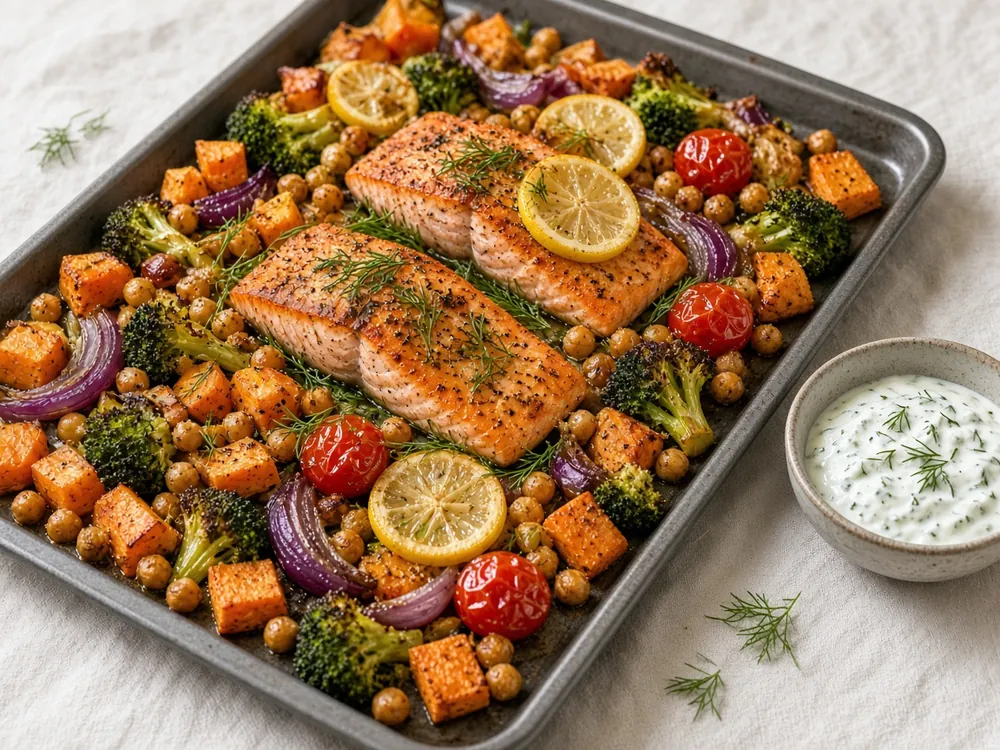
- 1 can (15 oz) chickpeas, rinsed and patted dry; 1 medium sweet potato, cubed
- 1 head broccoli in florets, 1 red onion in wedges, 1 cup cherry tomatoes
- 3 tbsp olive oil, 1 tsp smoked paprika, salt and pepper
- 4 salmon fillets (about 5 oz each), 1 lemon, fresh dill
- Sauce: ¾ cup plain Greek yogurt, 1 grated garlic clove, lemon juice, chopped dill
Method: Heat the oven to 425°F (220°C). Toss the chickpeas, sweet potato and onion with 2 tbsp oil and paprika and roast 12 minutes. Add the broccoli and tomatoes, nestle in the salmon brushed with the last of the oil, top with lemon slices and roast 12 to 14 minutes, until the salmon flakes easily. Serve with the yogurt sauce and fresh dill.
2. Berry flax overnight oats
In a jar, stir ½ cup rolled oats, 2 tbsp ground flaxseed, 1 tbsp chia seeds, ½ cup plain Greek yogurt and ½ cup milk of your choice. Refrigerate overnight and top with berries and a few walnuts. You get protein, fiber and omega-3 fats before 9 a.m.
3. Red lentil and vegetable soup
Sauté 1 onion, 2 carrots and 2 celery ribs in olive oil, add 2 garlic cloves, 1 tsp cumin and 1 tsp turmeric, then 1 cup rinsed red lentils, a can of diced tomatoes and 5 cups of broth. Simmer 20 minutes, stir in two handfuls of spinach and finish with lemon. It freezes well, so make a double batch.
4. Edamame, quinoa and crunchy veg salad
Toss 2 cups cooked quinoa with 1½ cups shelled edamame, shredded red cabbage, cucumber, grated carrot, scallions and pumpkin seeds. Dress with 2 tbsp olive oil, 1 tbsp rice vinegar, 1 tsp miso and a little grated ginger. It holds up in the fridge for 3 days, so it's ideal for lunches.
5. Greek yogurt pear-walnut bowl
Spoon 1 cup plain Greek yogurt or kefir into a bowl and top with a sliced ripe pear, a small handful of walnuts, 1 tbsp ground flax and a pinch of cinnamon. It's a satisfying snack or an easy dessert with protein, fiber and live cultures.
A sample perimenopause day
| Meal | What to eat | Why it helps |
|---|---|---|
| Breakfast | Berry flax overnight oats | Protein, fiber and omega-3s to start the day |
| Lunch | Edamame, quinoa and crunchy veg salad | Plant protein and many plant types |
| Snack | Greek yogurt pear-walnut bowl | Live cultures and steady energy |
| Dinner | Salmon and chickpea sheet-pan dinner | Protein for muscle, fiber and healthy fats |
| Evening | Herbal tea, screens off early | Supports a calmer wind-down and sleep |
This article is for general wellness education and isn't medical advice. Please talk with your healthcare provider about menopause symptoms and before changing your diet or exercise, especially if you take medication or have a health condition.
Frequently asked questions
Why do I have more belly fat in menopause?
During the menopause transition, falling estrogen changes where the body tends to store fat, and muscle becomes harder to keep. In the SWAN study, the rate of fat gain doubled and lean mass declined at the start of the transition. Sleep changes, stress and alcohol can add to it. It is a common, normal change, and your healthcare provider can help you look at your overall health.
What are the best foods for menopause belly?
No food targets belly fat. Meals built on protein (fish, eggs, Greek yogurt, tofu, beans), fiber from many plants, a fermented food and healthy fats like olive oil, nuts and flaxseed support muscle, digestion and steady energy, which is what most women want to feel in midlife.
What should I eat in perimenopause?
Aim for protein at every meal, plenty of vegetables, fruit, beans and whole grains, a fermented food most days, healthy fats and enough water. Easy perimenopause recipes include berry flax overnight oats, a salmon and chickpea sheet-pan dinner, red lentil soup and an edamame quinoa salad.
Does strength training help in menopause?
Strength training two or three times a week helps protect muscle and bone as estrogen falls, and it pairs well with a protein-rich diet. Check with your healthcare provider before starting a new exercise program.
Is this a weight-loss plan?
No. These are everyday wellness habits and recipes to help you feel your best in midlife. If you have questions about your weight, symptoms or hormone therapy, please talk with your healthcare provider or a registered dietitian.
Your next step
Choose one habit for the next seven days: protein at breakfast, or one new plant food each day. Notice your energy and sleep, then add the next habit.
- 🎁 Get my free 5 Midlife Food Habits guide with a sample day and my Berry Flax Overnight Oats.
- 📚 The book: Nourished Through the Change, my real-food guide to perimenopause and menopause.
- 🌿 Want a guided plan for your gut? The 21-Day Gut Reset ($47) includes a 7-day meal plan, 32 recipes and habit trackers.

Birgit Waites, M.S.
Birgit Waites, M.S. is a Celebrity Nutritionist with an M.S. in Natural Medicine and a Board Certified Holistic Health Practitioner (AADP), with 20+ years of experience in holistic nutrition. She's the author of Healing From Within and Nourished Through the Change, and these days she's traveling the world, cooking and writing as she goes.
Disclaimer
Wellness education, not medical advice. Content in this article is for general educational purposes only and is not intended to diagnose, treat, cure or prevent any disease. Please talk with your healthcare provider before changing your diet, exercise or supplements, especially if you have a medical condition, are pregnant or nursing, or take medication.