
Foods That Lower Cortisol: What Research Says About “Cortisol Belly,” Stress and Your Plate
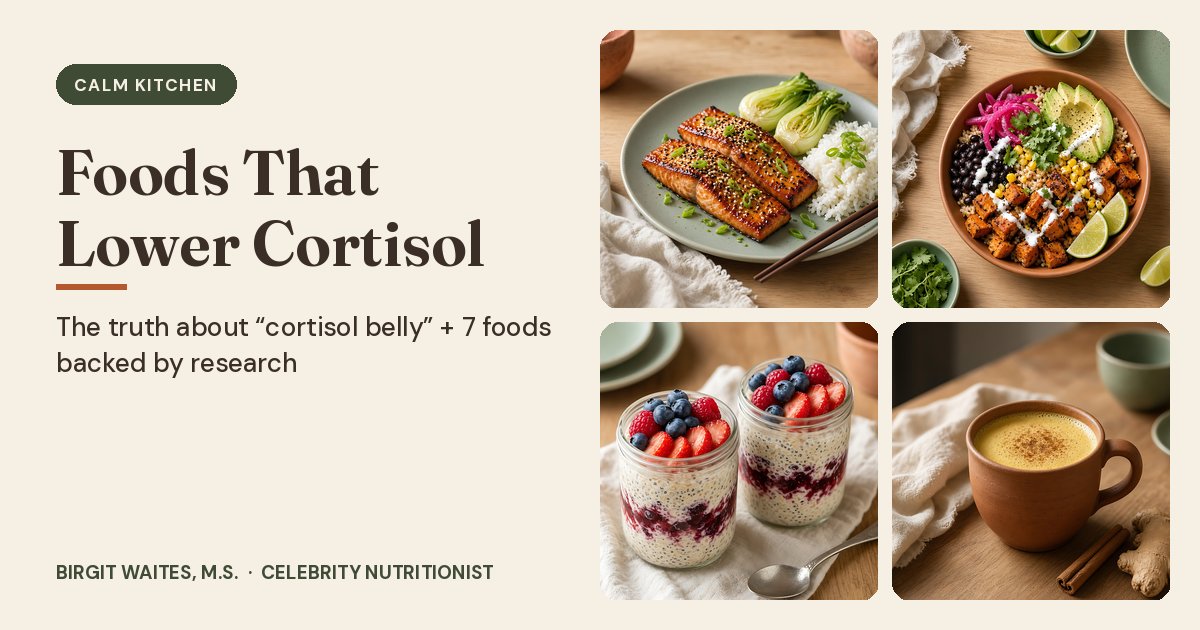
Quick answer: No single food or viral “cortisol cocktail” melts belly fat, and medical cortisol excess (Cushing’s syndrome) is rare. However, human clinical trials link a polyphenol-rich Mediterranean diet, omega-3-rich fish (salmon, sardines), magnesium-rich plants (pumpkin seeds, chia seeds, spinach, black beans, edamame), fermentable prebiotic fiber and live fermented foods to healthier cortisol rhythms and lower stress reactivity. Your plate works best alongside regular protein-and-fiber meals, a early-afternoon caffeine cut-off, 3-minute slow-breathing resets and 7 to 8 hours of sleep.
Lately, you can barely open your phone without seeing the word cortisol. “Cortisol belly.” “Cortisol face.” “Cortisol cocktails.” In my own Google Trends check this week, searches asking “is cortisol belly a real thing” surged by 250%, and millions of men and women are wondering whether a hidden stress hormone is the reason their jeans fit differently, their face looks puffy in the morning, or their eyes pop open at 3 a.m.
After 20+ years in holistic nutrition, here is my calm, honest answer: stress is very real, and it shows up in how we sleep, digest and store energy—but most of what goes viral online turns a normal survival hormone into a scary, sellable myth. You don't need an expensive powder or a salty orange-juice drink. You need a plate and a daily rhythm that help your nervous system, your gut and your blood sugar feel safe again.
At a Glance: What the Science Shows
- “Cortisol belly” is a nickname, not a medical diagnosis: True pathological cortisol excess (Cushing’s syndrome) affects only 40 to 70 people per million (NIDDK). Everyday midsection weight gain is usually driven by chronic stress paired with short sleep, blood-sugar swings, midlife hormone shifts and loss of muscle.
- Short sleep drives stress eating: A meta-analysis of 11 human trials (n = 172) found that partial sleep deprivation increased daily food intake by 385 calories per day, with higher fat and lower protein intake (Al Khatib et al., European Journal of Clinical Nutrition, 2017).
- Polyphenols & Mediterranean eating support morning cortisol: In the 18-month DIRECT-PLUS randomized clinical trial (n = 294), a polyphenol-rich Green-Mediterranean diet (including walnuts and green tea) lowered fasting morning cortisol alongside improved metabolic markers (Segev et al., Frontiers in Endocrinology, 2023).
- Omega-3s and magnesium have randomized human trial data: Four months of omega-3s (2.5 g/day) lowered total salivary cortisol during an acute stress test by 19% in 138 midlife adults (Madison et al., Molecular Psychiatry, 2021), and 24 weeks of magnesium (350 mg/day) lowered 24-hour urinary cortisol in 49 overweight adults (Schutten et al., Clinical Endocrinology, 2020).
- Skip OTC “adrenal support” pills: When Mayo Clinic researchers tested 12 over-the-counter “adrenal support” supplements, all 12 contained unlisted thyroid hormone and most contained steroid hormones (Akturk et al., Mayo Clinic Proceedings, 2018).
What does cortisol actually do, and is “cortisol belly” real?
Cortisol is your body's primary stress and wakefulness hormone, made by two small adrenal glands above your kidneys. According to the U.S. National Library of Medicine (MedlinePlus), cortisol touches almost every organ system: it helps regulate blood pressure, blood sugar, inflammation, metabolism and your sleep-wake cycle.
Cortisol is not a villain. In a healthy rhythm, it is supposed to be highest in the morning—rising sharply in the 30 to 45 minutes after you wake up (the cortisol awakening response) to help you feel alert—and then gradually falling all day until it reaches its lowest point around bedtime (Stalder et al., Psychoneuroendocrinology, 2016).
Why stress shows up around your middle
When stress is constant and recovery disappears, your hypothalamic-pituitary-adrenal (HPA) axis stays switched on. Deep abdominal fat (visceral fat) has more glucocorticoid receptors and greater blood flow than fat elsewhere in the body. Over time, chronic stress, disrupted sleep, skipped meals followed by late-night snacking, and declining estrogen or testosterone in midlife encourage your body to store more energy around your midsection.
That pattern is what social media calls “cortisol belly.” It isn't a separate disease you fix with a miracle tea. In women over 40, it often overlaps with the hormonal shifts I cover in Foods to Eat During Menopause, and in men over 40 it often intersects with the nutrient and sleep patterns in Foods That Increase Testosterone Naturally. Supporting your body means calming the upstream signals: steadier blood sugar, nutrient-dense whole foods, gut microbiome diversity and deeper rest.
Viral “cortisol” trends vs. what the clinical evidence actually shows
Before we stock your kitchen, let's clear up the five biggest claims circulating online right now.
| Viral trend or claim | What the published evidence actually says | What to do instead |
|---|---|---|
| “Cortisol belly” is caused by a broken metabolism you can fix with a special drink | No drink targets abdominal fat. True medical cortisol excess (Cushing's syndrome) is rare (40–70 cases per million, NIDDK). Everyday midsection weight is tied to chronic stress, short sleep (+385 kcal/day), blood-sugar swings and muscle loss. | Build meals around 25–30 g of protein and fermentable fiber, protect 7–8 hours of sleep and lift weights twice a week. |
| “Cortisol face” (morning facial puffiness) means your cortisol is dangerously high | A round “moon face” is a clinical sign of Cushing's syndrome or high-dose steroid medication (Lacroix et al., The Lancet, 2015). Everyday morning puffiness is far more often linked to salty dinners, alcohol, poor sleep, allergies or normal fluid shifts. | Ease off late-evening alcohol and ultra-processed salty snacks, hydrate through the day and check with your doctor if swelling is new or persistent. |
| “Cortisol cocktails” (orange juice, coconut water and salt) lower stress hormones | Zero human clinical trials show this drink lowers cortisol. It is simply vitamin C, potassium, sodium and about 15–20 g of fast-absorbing sugar. On an empty stomach, that sugar can trigger a quick glucose spike and dip. | If you enjoy the taste, drink a small glass alongside a protein-rich breakfast (like eggs or Greek yogurt) rather than on an empty stomach. |
| “Adrenal fatigue” explains why you feel wired at night and exhausted all day | A systematic review of 58 studies found no scientific substantiation that “adrenal fatigue” is an actual medical condition (Cadegiani & Kater, BMC Endocrine Disorders, 2016). However, burnout, iron or B12 deficiency, thyroid shifts, perimenopause and sleep apnea are very real. | Ask your healthcare provider for a proper checkup (iron/ferritin, thyroid panel, vitamin D, B12, HbA1c and sleep evaluation) instead of buying a home saliva kit. |
| “Adrenal support” or “cortisol blocker” supplements are a gentle natural fix | In a Mayo Clinic study of 12 over-the-counter “adrenal support” supplements, 100% contained hidden thyroid hormone (T3) and most contained steroid hormones (Akturk et al., Mayo Clinic Proceedings, 2018). | Put food first: magnesium-rich seeds, greens and beans, omega-3 fish and fermented foods. Discuss any single-ingredient supplement with your doctor or pharmacist first. |
When to see a doctor promptly: According to the NIDDK, signs that deserve a medical evaluation for true cortisol excess include easy bruising, wide purple stretch marks on the abdomen, progressive muscle weakness in the upper arms or thighs, a fatty hump between the shoulders, and new or worsening high blood pressure or blood sugar.
Which foods help lower cortisol naturally? 7 foods from human studies
No single food acts like an off-switch for stress. Instead, human trials point to a whole-food pattern that supplies polyphenols, omega-3 fatty acids, magnesium, fermentable fiber and live microbes—nutrients that cushion the HPA axis and keep your gut and brain on friendly terms.
1. Polyphenol-rich plants, walnuts and green tea (the Green-Mediterranean pattern)
In the 18-month DIRECT-PLUS randomized controlled trial of 294 adults (Frontiers in Endocrinology, Segev et al., 2023), researchers compared standard healthy dietary guidelines against a Mediterranean diet and a high-polyphenol Green-Mediterranean diet (which included 28 g of walnuts per day and 3 to 4 cups of green tea per day, with less red and processed meat). Both Mediterranean groups improved metabolic markers, and the high-polyphenol Green-Mediterranean group showed the most favorable reductions in fasting morning cortisol, alongside better blood-sugar control (HbA1c) and lower visceral fat.
Put it on your plate: - A small handful (1 oz / 28 g) of walnuts on morning oatmeal or yogurt - 1 to 2 cups of green tea before noon (it also brings L-theanine, an amino acid studied for calm focus in a 4-week randomized trial by Hidese et al., Nutrients, 2019) - Deeply colored berries, extra-virgin olive oil, dark leafy greens and herbs at lunch and dinner (many of the same foods support younger-looking, glowing skin)
2. Oily fish and omega-3 fats: salmon, sardines, mackerel, chia and flax
Omega-3 fatty acids help regulate inflammation and blunt how sharply your stress system reacts to a hard day. In a 4-month randomized controlled trial at Ohio State University (Molecular Psychiatry, Madison et al., 2021), 138 sedentary, overweight midlife adults took either 2.5 g/day of omega-3, 1.25 g/day of omega-3, or a placebo before undergoing a standardized laboratory stress test. The 2.5 g/day omega-3 group had 19% lower total salivary cortisol and 33% lower inflammatory IL-6 during stress compared with the placebo group. A separate meta-analysis of 19 clinical trials (n = 1,203) also linked omega-3 intake to reduced anxiety symptoms (Su et al., JAMA Network Open, 2018).
Put it on your plate: - Wild salmon, sardines, mackerel or trout twice a week (canned salmon and sardines are budget-friendly kitchen staples) - Plant omega-3s (ALA) every day: 1 to 2 tablespoons of chia seeds, ground flaxseed or hemp seeds, plus walnuts
3. Magnesium-rich foods: pumpkin seeds, chia, spinach, black beans and edamame
Magnesium helps regulate neurotransmitters and the enzymes that clear cortisol, yet the NIH Office of Dietary Supplements notes that roughly half of U.S. adults eat less magnesium than recommended (310–320 mg/day for women and 400–420 mg/day for men).
In a 24-week randomized controlled trial of 49 overweight men and women aged 45 to 70 (Clinical Endocrinology, Schutten et al., 2020), 350 mg/day of magnesium significantly reduced 24-hour urinary cortisol excretion (-32 nmol/24-h, p = 0.021) and increased the activity of the enzyme (11β-HSD type 2) that converts active cortisol into inactive cortisone.
You can hit 350+ mg of magnesium every day from ordinary groceries. Save this chart for your next shopping trip:
| Everyday food | Portion | Magnesium (NIH ODS) | Easy way to eat it |
|---|---|---|---|
| Pumpkin seeds (pepitas), roasted | 1 oz (2 tbsp) | 156 mg | Sprinkle on yogurt, oatmeal, soup or salads |
| Chia seeds | 1 oz (2 tbsp) | 111 mg | Stir into overnight oats, yogurt or smoothies |
| Almonds, dry roasted | 1 oz (~23 almonds) | 80 mg | Pair with an apple for a 3 p.m. snack |
| Spinach, cooked | ½ cup | 78 mg | Wilt into eggs, lentil soup or pasta |
| Cashews, dry roasted | 1 oz | 74 mg | Toss into a veggie and tofu stir-fry |
| Soy milk, unsweetened | 1 cup | 61 mg | Use in smoothies, oats or evening golden milk |
| Black beans, cooked | ½ cup | 60 mg | Build a sweet potato & black bean lunch bowl |
| Edamame, shelled, cooked | ½ cup | 50 mg | Steam with a pinch of sea salt and lemon |
| Baked potato with skin | 3.5 oz | 43 mg | Top with Greek yogurt, chives and black beans |
| Plain Greek or low-fat yogurt | 1 cup (8 oz) | 42 mg | Breakfast base with berries and seeds |
Source: NIH Office of Dietary Supplements Magnesium Fact Sheet. If you have kidney disease, always ask your doctor before taking magnesium supplements.
4. Fermentable prebiotic fiber: oats, barley, beans, lentils, onions and garlic
Your gut and your adrenal stress response talk constantly along the gut-brain axis. When you feed beneficial gut microbes fermentable fibers—like beta-glucan in oats and barley, galacto-oligosaccharides (GOS) in beans and lentils, and inulin in onions, garlic, leeks and asparagus—they produce short-chain fatty acids (SCFAs) such as butyrate.
In human research, prebiotic fibers and whole-food Mediterranean eating have shown encouraging effects on stress physiology and mood: - In a randomized controlled crossover trial of 70 adults with moderate sleep disturbances (Schaafsma et al., Nutrients, 2021), an evening dairy-and-prebiotic (GOS) nourishment increased beneficial Bifidobacterium and lowered early-morning salivary cortisol. - In the landmark SMILES randomized trial (n = 67, Jacka et al., BMC Medicine, 2017), adults who shifted from a processed diet to a fiber-rich Mediterranean plate (vegetables, fruit, whole grains, legumes, nuts, fish and olive oil) alongside their usual care experienced significant mood improvements compared with social support alone.
Prebiotic fibers also trigger your gut's natural fullness signals—a mechanism I explain in detail in Natural GLP-1 Foods, Gut Health Foods List: What to Eat for Gut Health (and Bloating) and The Gut-Brain Connection: Foods for Mood, Stress and Energy.
5. Live fermented foods: plain yogurt, kefir, raw sauerkraut, kimchi and miso
Can probiotics lower cortisol? A 2026 GRADE-based dose-response meta-analysis of 41 randomized controlled trials (BMC Nutrition, Gandomkar et al., 2026) found that probiotic supplements were associated with a modest reduction in serum cortisol (-0.35 µg/dL, p < 0.001), but the authors rated the certainty of evidence as very low because supplement studies used wildly different strains and doses.
Food-first fermented foods, on the other hand, deliver live microbes plus protein, minerals and bioactive peptides. In Stanford University's 10-week randomized clinical trial (Cell, Wastyk et al., 2021), adults who ate fermented foods daily (plain yogurt, kefir, fermented cottage cheese, kimchi, raw sauerkraut and vegetable brine drinks) increased their gut microbiome diversity and lowered 19 inflammatory proteins, including IL-6.
The Fridge Rule: Add 1 to 2 forkfuls of raw sauerkraut or kimchi to lunch, or enjoy 1 cup of plain Greek yogurt or kefir at breakfast. Always check the label for “live and active cultures” or “unpasteurized” in the refrigerated section.
6. Regular, protein-and-fiber meals (stopping the blood-sugar roller coaster)
When life gets hectic, many people run on black coffee until 1 p.m., grab a quick pastry or refined-carb snack, and then wonder why their heart is racing and their hands feel shaky by 3:30 p.m. When blood sugar drops sharply after a spike, your body releases counter-regulatory hormones—including adrenaline and cortisol—to bring glucose back up. That dip feels almost identical to anxiety.
The U.S. National Institute of Mental Health (NIMH) lists healthy, regular meals right alongside sleep and movement as a foundational stress-coping habit. Aim for: - Breakfast within 1 to 2 hours of waking, anchored by 25 to 30 g of protein and fiber (never coffee alone) - Balanced meals every 4 to 5 hours so carbs always travel with protein, fiber or healthy fat - Vegetables and protein first on your plate before starches
7. Gentle evening swaps: caffeine cut-offs, alcohol-free nights and warm rituals
What is in your cup at 2 p.m. and 8 p.m. shapes tomorrow morning's cortisol rhythm more than almost anything else in your kitchen:
- Move coffee to after breakfast, and cut it off 6 to 8 hours before bed: In a controlled crossover trial (Lovallo et al., Psychosomatic Medicine, 2005), caffeine increased cortisol secretion across the waking hours in healthy men and women. And in a sleep-laboratory study (Drake et al., Journal of Clinical Sleep Medicine, 2013), caffeine taken even 6 hours before bedtime cut total sleep by more than an hour.
- Swap the evening nightcap for sparkling water or golden milk: Alcohol may make you feel drowsy at first, but a comprehensive review of sleep studies (Ebrahim et al., Alcoholism: Clinical and Experimental Research, 2013) shows it fragments REM sleep and wakes you up in the second half of the night—right around 2 or 3 a.m.
Why sleep and 3-minute breathing resets matter as much as food
You can eat all the pumpkin seeds and wild salmon in the world, but if you are sleeping five hours a night and holding your breath over your inbox, your stress response will stay loud.
The 385-calorie sleep connection
In a systematic review and meta-analysis of 11 human intervention studies (n = 172) published in the European Journal of Clinical Nutrition (Al Khatib et al., 2017), researchers found that partial sleep deprivation caused adults to eat an average of 385 extra calories the next day—mostly from higher-fat, lower-protein snacks—with no increase in calories burned. Protecting a consistent wake time, getting 10 minutes of outdoor morning light, and dimming screens an hour before bed are nutrition habits in disguise. (My free 5 Rest-Well Habits guide walks you through the full evening routine.)
The 5-minute Stanford breathing reset (“cyclic sighing”)
Breathing is the one lever of your stress response you can steer on purpose, anywhere, for free. In a 1-month randomized controlled trial at Stanford University (Cell Reports Medicine, Balban et al., 2023, n = 111), just 5 minutes a day of cyclic sighing improved mood and lowered resting breathing rate significantly more than mindfulness meditation:
- Inhale slowly through your nose until your lungs are comfortably full.
- Take a second, short “sip” of air at the top to fully expand your lungs.
- Exhale slowly and completely through your mouth (make the exhale twice as long as the inhale).
- Repeat for 3 to 5 minutes before lunch, at 3 p.m. while the kettle boils, or in bed if you wake up at night.
A 1-day “Calm Kitchen” meal plan (380+ mg magnesium, 35+ g fiber)
Here is what a calm, cortisol-supportive day looks like on an ordinary grocery budget—no powders, no fasting and no calorie counting:
| Time / Rhythm | What to eat & do | Why it supports a calmer cortisol rhythm |
|---|---|---|
| Wake + Morning Light | 1 glass of water + 5 minutes of outdoor daylight + 5 slow cyclic sighs | Anchors your natural morning cortisol peak and tonight's melatonin clock |
| Breakfast (within 90 min) | Pumpkin Seed & Berry Yogurt Bowl: 1 cup plain Greek yogurt (or soy yogurt), 1 cup berries, 2 tbsp roasted pumpkin seeds, 1 tbsp chia seeds, 2 tbsp rolled oats, cinnamon + morning coffee with food | ~30 g protein, 10 g fiber, ~300 mg magnesium in one bowl; prevents a mid-morning glucose dip |
| Midday | Salmon, Quinoa & Edamame Bowl: ½ cup cooked quinoa, ½ cup shelled edamame, 2 handfuls spinach & cucumber, baked or canned salmon, extra-virgin olive oil + lemon, 1 forkful raw sauerkraut | Omega-3s (Madison et al., 2021), magnesium (~130 mg), live fermented microbes + a 10-minute outdoor walk |
| 2:30 p.m. (Caffeine Cut-Off) | 1 cup green tea (last caffeine of the day) + 1 apple with 1 oz dry-roasted almonds | Polyphenols & L-theanine (DIRECT-PLUS trial), 80 mg magnesium, pectin fiber |
| Dinner (3+ hrs before bed) | Comforting Red Lentil & Spinach Dal (or Black Bean & Sweet Potato Bowl) with garlic, ginger, turmeric, olive oil and a small scoop of brown rice | Fermentable prebiotic fiber for overnight SCFA production + gentle evening carbohydrates |
| Evening Wind-Down | Warm Caffeine-Free Golden Milk (unsweetened soy or dairy milk, turmeric, ginger, cinnamon) + dim lights + 3 minutes of cyclic sighing | Zero late alcohol or caffeine; warm protein-and-spice ritual signals safety before sleep |
Screenshot Checklist: 5 Smart Grocery Swaps for Stressful Seasons
- ✔️ Swap black coffee on an empty stomach → Coffee with a 25–30 g protein breakfast (eggs, Greek yogurt or savory oats)
- ✔️ Swap sugary “cortisol cocktails” → A 2-tablespoon jar of roasted pumpkin seeds + chia seeds on breakfast (~267 mg of real food magnesium)
- ✔️ Swap afternoon energy drinks → Green tea before 2 p.m. + a 3-minute walk and cyclic sighing at 3 p.m.
- ✔️ Swap ultra-processed salty snacks → Edamame, almonds or walnuts + berries or an apple
- ✔️ Swap the evening glass of wine → Tart cherry spritzer with lime or warm caffeine-free golden milk
Want the printable recipes, magnesium chart and 3-minute reset menu on your fridge? Grab my free 5 Calm-Kitchen Habits guide.
Frequently asked questions
What foods lower cortisol naturally?
No single food switches cortisol off immediately, but human clinical trials link a polyphenol-rich Mediterranean diet (vegetables, berries, extra-virgin olive oil, walnuts, green tea), omega-3-rich fish (salmon, sardines, mackerel), magnesium-rich plants (pumpkin seeds, chia seeds, spinach, almonds, black beans, edamame), prebiotic fibers and fermented foods to healthier cortisol rhythms and lower stress reactivity.
Is “cortisol belly” a real thing, and how do you get rid of it?
“Cortisol belly” is a social-media nickname, not a medical diagnosis. While chronic stress and high cortisol encourage visceral fat storage around the abdomen, true medical cortisol excess (Cushing's syndrome) is rare, affecting 40 to 70 people per million. The best evidence supports regular meals with 25 to 30 grams of protein and fiber, strength training, 7 to 8 hours of sleep, less alcohol and daily stress resets.
Do “cortisol cocktails” actually work?
No clinical studies show that a “cortisol cocktail” (orange juice, coconut water and salt) lowers cortisol levels or reduces belly fat. It simply provides vitamin C, potassium, sodium and about 15 to 20 grams of fast-digesting sugar. If you enjoy the flavor, drink a small glass alongside a protein-and-fiber breakfast so it doesn't spike and crash your blood sugar.
Why do I wake up at 3 a.m. feeling wired?
Waking up between 2 a.m. and 4 a.m. is rarely caused by a single nutrient deficiency. Common culprits include late-afternoon caffeine, an evening glass of alcohol (which fragments second-half sleep), perimenopause or menopause night sweats, a heavy or sugary late dinner, or daytime stress. Keep caffeine to the morning, skip evening alcohol, eat a balanced dinner three hours before bed and use slow long-exhale breathing if you wake.
What supplements lower cortisol, and are “adrenal support” pills safe?
In human randomized trials, omega-3 fish oil (2.5 g/day) and magnesium (350 mg/day) showed modest benefits for cortisol regulation, while ashwagandha and L-theanine have smaller, short-term studies for perceived stress. Avoid multi-ingredient “adrenal support” pills: a 2018 Mayo Clinic study found all 12 tested over-the-counter adrenal supplements contained unlisted thyroid hormone and most contained steroid hormones. Always consult your doctor or pharmacist first.
Does coffee raise cortisol?
Yes, temporarily. Controlled human studies show caffeine stimulates cortisol release across waking hours, though the spike is smaller in habitual coffee drinkers. Drinking coffee on an empty stomach or after midday is most likely to leave you feeling jittery and disrupt deep sleep that night. Enjoy coffee with or right after a protein-rich breakfast and set a cut-off at least 6 to 8 hours before bedtime.
Your next step
You don't need to fix your whole life by Friday. Pick one calm habit for the next seven days: eat breakfast before coffee, toss two tablespoons of pumpkin seeds onto your lunch, or do three minutes of cyclic sighing at 3 p.m. Notice how your afternoons and your sleep respond.
- 🎁 Get my free 5 Calm-Kitchen Habits guide for the printable magnesium foods cheat sheet, 3-minute resets and my Pumpkin Seed & Berry Yogurt Bowl recipe.
- 🌙 Download my free 5 Rest-Well Habits guide for evening food timing, a caffeine cut-off table and Tart Cherry & Walnut Overnight Oats.
- 📚 Browse all 9 free printable guides, including the Gut-Brain Starter Kit, 5 Steady-Energy Habits and my printable Food & Mood Journals.
- 🌿 Ready for a step-by-step reset? My 21-Day Gut Reset walks you through fiber diversity, fermented foods and 3-minute nervous-system rhythms one day at a time, with a 68-page workbook, 7-day meal plan and 32 recipes.
- ▶️ Prefer video? Subscribe on YouTube for weekly real-food nutrition.

Birgit Waites, M.S.
Birgit Waites, M.S. is a Celebrity Nutritionist with an M.S. in Natural Medicine and a Board Certified Holistic Health Practitioner (AADP), with 20+ years of experience in holistic nutrition. She's the author of Healing From Within and Nourished Through the Change, and these days she's traveling the world, cooking and writing as she goes.
Disclaimer
Wellness education, not medical advice. Content in this article is for general educational purposes only and is not intended to diagnose, treat, cure or prevent any disease. Please talk with your healthcare provider before changing your diet, exercise or supplements, especially if you have a medical condition, are pregnant or nursing, or take medication.