
Fibermaxxing: Is It Healthy? A Nutritionist's Smart-Fiber Guide
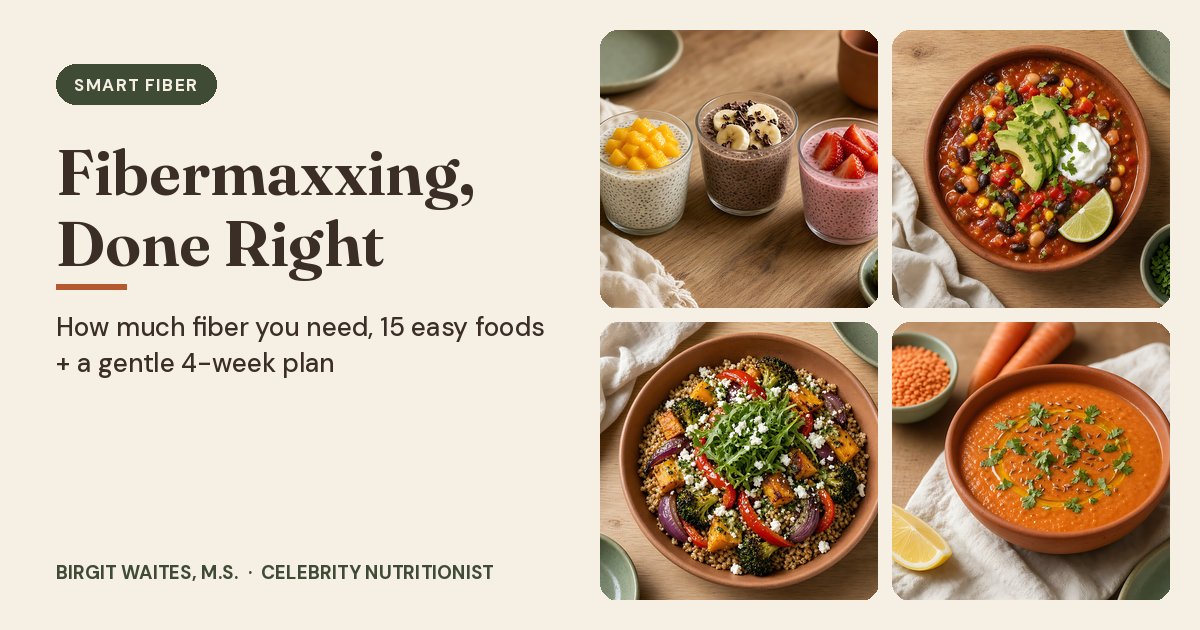
Quick answer: Fibermaxxing (eating as much fiber as possible) gets one big thing right: most adults eat far too little fiber, and research links higher intakes of around 25 to 29+ grams a day from whole foods to better long-term health. Where the trend goes wrong is speed and sameness. The smarter version is fiber diversity: reach roughly 22 to 34 grams a day (depending on your age and sex) from many different plants, add about 5 grams a week, drink more water as you go, and favor beans, lentils, oats, chia, berries, vegetables and nuts over powders and stacked fiber bars.
If your feed has been full of chia puddings, bean-loaded "fiber bowls" and people counting grams like protein, you have met fibermaxxing. Its cousin, "poopmaxxing," is the same idea with a less polite name. As someone who has spent 20+ years helping people eat for better digestion, I'm genuinely happy fiber is finally having its moment. I'm also seeing the side effects of doing it too fast: bloating, cramps and people giving up on beans for good.
So let's keep the good part and skip the stomachache.
At a glance: what the research shows
- Most people are short on fiber. An estimated 95% of American adults and children don't meet fiber recommendations (Quagliani & Felt-Gunderson, American Journal of Lifestyle Medicine, 2017).
- More whole-food fiber is linked to better long-term health. A large series of reviews and meta-analyses commissioned by the World Health Organization found people eating 25 to 29 g of fiber a day had a 15% to 30% lower risk of dying from any cause and of heart disease, stroke, type 2 diabetes and colorectal cancer compared with the lowest intakes (Reynolds et al., The Lancet, 2019). These are associations, not proof that fiber alone caused the difference.
- Variety matters for your gut bacteria. In the American Gut Project, people eating 30+ different plant foods a week had more diverse gut microbes than people eating 10 or fewer (McDonald et al., mSystems, 2018).
- Fiber feeds the microbes that make butyrate, a short-chain fatty acid that nourishes the cells lining your colon (Koh et al., Cell, 2016).
What is fibermaxxing?
Fibermaxxing is a social-media trend where people try to eat as much fiber as they can each day, often by piling chia seeds, beans, lentils, oats, berries and fiber supplements into every meal. The goal is better digestion, longer fullness and steadier energy. The intention is good, but "max" is the wrong target. The real goal is enough fiber, from many kinds of plants, added gradually.
How much fiber do you actually need per day?
Most adults do well with roughly 22 to 34 grams of fiber a day, a range based on about 14 grams for every 1,000 calories eaten. Women usually land around 22 to 28 grams and men around 28 to 34 grams, depending on age. In the large Lancet analysis, the benefits kept trending upward slightly above 30 grams, so more isn't harmful for most people, as long as you build up slowly and drink enough fluid.
A quick way to picture it: one cup of cooked lentils has about 15 grams, two tablespoons of chia about 8 to 10 grams, a cup of raspberries about 8 grams and a medium pear about 5 to 6 grams. A few smart swaps get you there without counting every bite.
Is fibermaxxing healthy, or can you eat too much fiber?
Eating more whole-food fiber is healthy for most people, but jumping from 10 grams to 50 grams overnight is not. Your gut bacteria need time to adjust, and a sudden jump often brings gas, bloating, cramping and constipation, especially without extra water. Very high intakes from supplements can also make some medications and minerals absorb less well when taken at the same time.
Here's what I tell clients:
- Add about 5 grams a week, not 30 grams a day.
- Drink more as you go. Soluble fiber pulls water into the gut. Without enough fluid, it can make things slower, not faster.
- Spread it out. Some fiber at every meal is gentler than one giant "fiber bomb" bowl.
- Food before powders. Whole plants bring polyphenols, vitamins and minerals that a fiber gummy doesn't. That said, research does support fiber supplements, especially psyllium, for chronic constipation in adults (van der Schoot et al., American Journal of Clinical Nutrition, 2022), so a supplement can be a reasonable tool to discuss with your healthcare provider.
Who should talk to a provider first: people with IBS, IBD (Crohn's or ulcerative colitis), gastroparesis, a history of bowel obstruction or recent abdominal surgery, and anyone on medications that can interact with fiber supplements.
What's the difference between soluble and insoluble fiber?
Soluble fiber dissolves in water and forms a soft gel. It's found in oats, barley, chia, flax, beans, apples and citrus, and it supports fullness and steadier blood sugar. Insoluble fiber doesn't dissolve. It adds bulk and helps things move, and you'll find it in wheat bran, whole grains, nuts, seeds and vegetable skins. Most whole plants contain both, which is one more reason variety beats a single "hero" food.
There's also resistant starch, a fiber-like starch that feeds friendly bacteria. Cooking and then cooling potatoes, rice or oats increases it, so leftovers count.
The smart-fiber foods list: 15 easy high-fiber foods
Fiber amounts are approximate and vary by brand and portion.
| Food | Portion | About how much fiber | Easy way to use it |
|---|---|---|---|
| Lentils (cooked) | 1 cup | 15 g | Soups, salads, a scoop in pasta sauce |
| Black beans (cooked) | ½ cup | 7 to 8 g | Tacos, bowls, blended into soup |
| Chickpeas (cooked) | ½ cup | 6 g | Roasted as a snack, hummus, curries |
| Green peas | 1 cup | 8 to 9 g | Stir into rice, pasta or omelets |
| Chia seeds | 2 tbsp | 8 to 10 g | Overnight pudding, smoothies, yogurt |
| Ground flaxseed | 2 tbsp | 4 g | Oatmeal, baking, smoothies |
| Raspberries | 1 cup | 8 g | Breakfast bowls, snacks |
| Pear (with skin) | 1 medium | 5 to 6 g | Sliced with nut butter |
| Avocado | ½ medium | 5 g | Toast, salads, bowls |
| Artichoke | 1 medium | 7 g | Roasted or in a warm grain salad |
| Broccoli (cooked) | 1 cup | 5 g | Sheet-pan dinners |
| Rolled oats (dry) | ½ cup | 4 g | Overnight oats, baked oatmeal |
| Barley or farro (cooked) | 1 cup | 6 g | In place of rice |
| Almonds | 1 oz (about 23) | 3 to 4 g | Snack, salad topping |
| Popcorn (air-popped) | 3 cups | 3 to 4 g | Afternoon snack with olive oil |
Want more gut-friendly options grouped by probiotic, prebiotic and bloating-friendly foods? See my Gut Health Foods List.
A gentle 4-week plan to increase fiber without bloating
| Week | Add this | Running daily total (roughly) |
|---|---|---|
| Week 1 | Swap your breakfast for overnight oats with 1 tbsp chia and berries, and add one extra glass of water | +5 to 7 g |
| Week 2 | Add ½ cup of beans or lentils to lunch or dinner 4 days this week | +5 to 7 g more |
| Week 3 | Make half your plate vegetables at dinner, and snack on a pear, apple or handful of almonds | +5 g more |
| Week 4 | Swap white rice or pasta for barley, farro, quinoa or whole-grain pasta a few times, and start counting different plants (aim for 30 a week) | +3 to 5 g more |
Tips that make a big difference: rinse canned beans well, start with smaller portions of lentils (they're often gentler than larger beans), chew slowly, and take a 10-minute walk after meals.
What does a day of smart fiber look like?
Here's a simple, satisfying day with roughly 35 grams of fiber and 20+ different plants:
- Breakfast: Overnight oats with chia, ground flax, raspberries, walnuts and cinnamon (about 14 g)
- Lunch: Lentil and roasted veggie bowl with spinach, parsley, olive oil and lemon (about 12 g)
- Snack: A pear with a few almonds (about 7 g)
- Dinner: Salmon or tofu with roasted broccoli and a small scoop of cooled brown rice, plus a forkful of sauerkraut (about 6 g)
If you're on a GLP-1 medication or have a small appetite, pairing fiber with protein matters even more. My guide to natural GLP-1 foods explains how protein and fiber work together on fullness.
Frequently asked questions
Is fibermaxxing good for you?
Eating more fiber from whole foods is good for most people, since about 95% of adults fall short. The healthy version is gradual: add about 5 grams a week, drink more water, and get fiber from many different plants, aiming for roughly 22 to 34 grams a day depending on your age and sex.
How much fiber is too much in a day?
There's no official upper limit for fiber from food, but many people feel bloated, gassy or constipated when they jump far above their usual intake quickly. Going well past 50 to 70 grams a day isn't needed for most people, and very high supplement intake can reduce absorption of some medications and minerals taken at the same time.
What are the best fibermaxxing foods?
The best everyday high-fiber foods are lentils, beans, chickpeas, green peas, chia seeds, ground flaxseed, raspberries, pears with the skin, avocado, artichokes, broccoli, oats, barley and nuts. Mixing many of them across the week gives your gut bacteria more variety than relying on one food or a fiber powder.
Why does fiber make me bloated?
Bloating usually happens when fiber increases faster than your gut bacteria can adjust, or when you don't drink enough water. Slow down to about 5 extra grams a week, spread fiber across meals, choose cooked vegetables and lentils first, and walk after eating. If bloating is persistent or severe, talk with your healthcare provider.
Is a fiber supplement as good as fiber from food?
Whole foods bring fiber plus vitamins, minerals and plant compounds that supplements don't, so food comes first. Supplements such as psyllium do have research support for chronic constipation, so they can be a helpful tool when food alone isn't enough. Check with your provider about timing if you take medications.
Your next step
Pick one swap this week: overnight oats with chia for breakfast, or half a cup of lentils at dinner. Notice how you feel after seven days, then add the next one.
- 🎁 Get my free Gut-Brain Starter Kit with my favorite gut-loving foods, a 3-day menu with 9 easy recipes, a printable shopping list and a daily food & mood tracker. More free printables are on my Free Guides page.
- 🌿 Want a guided plan for adding fiber gently? The 21-Day Gut Reset is my 68-page printable workbook with a 7-day meal plan, 32 recipes and habit trackers. You'll find all my programs and books in my Payhip shop.
- 📖 Keep reading: The Gut-Brain Connection: Foods for Mood, Stress and Energy and Gut Health Foods List.

Birgit Waites, M.S.
Birgit Waites, M.S. is a Celebrity Nutritionist with an M.S. in Natural Medicine and a Board Certified Holistic Health Practitioner (AADP), with 20+ years of experience in holistic nutrition. She's the author of Healing From Within and Nourished Through the Change, and these days she's traveling the world, cooking and writing as she goes.
Disclaimer
Wellness education, not medical advice. Content in this article is for general educational purposes only and is not intended to diagnose, treat, cure or prevent any disease. Please talk with your healthcare provider before changing your diet, exercise or supplements, especially if you have a medical condition, are pregnant or nursing, or take medication.