
Akkermansia Foods List: How to Increase Akkermansia Naturally
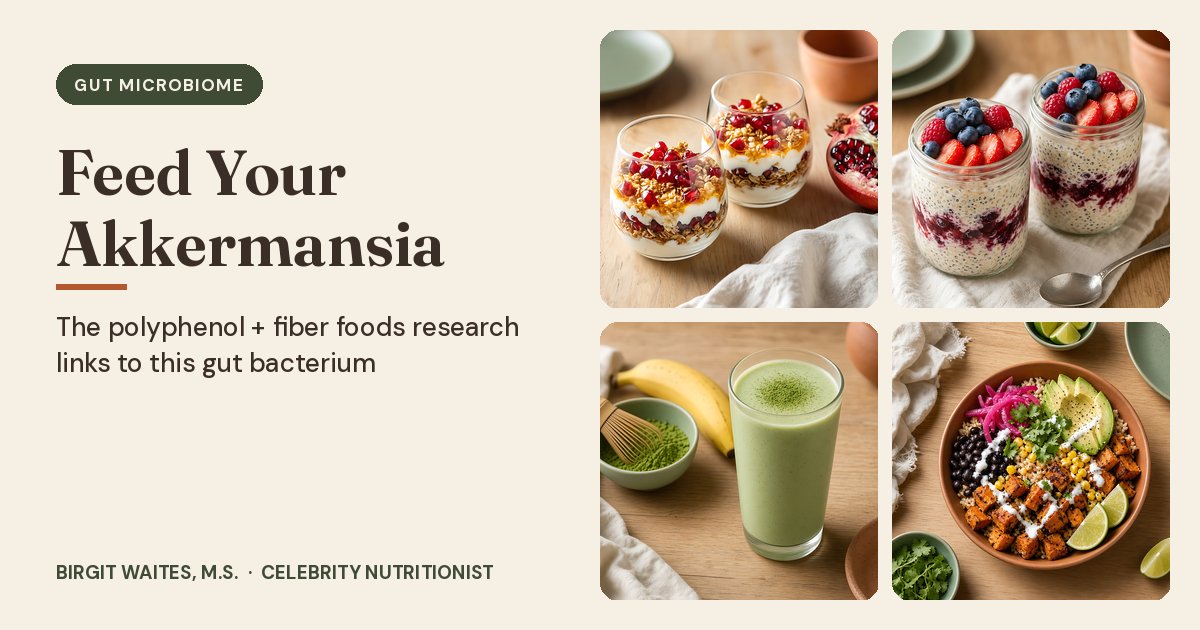
Quick answer: Akkermansia muciniphila is a gut bacterium that lives in the mucus lining of your intestines, and higher levels are linked in research to healthier metabolism. No food contains Akkermansia, but you can feed it. The foods studied most are polyphenol-rich plants (pomegranate, cranberries, Concord grapes, berries, green tea, cacao), fermentable fiber (oats, onions, garlic, leeks, chicory, beans and lentils) and an overall varied, plant-rich diet. Results differ a lot from person to person, so think "daily habits for weeks," not one magic food.
"Akkermansia" has gone from a lab name to one of the biggest gut-health searches of 2026. Trend tracker Rising Trends lists it as the largest nutrition search of the year, at millions of searches a month and up about 50% year over year (Rising Trends, Oct 2026). Most of what you'll find online is selling a capsule.
In my 20+ years in holistic nutrition, I've learned to ask a simpler question first: what can your plate do? Here's the honest, food-first guide to Akkermansia, what it is, what the studies really show, and the foods worth putting on your shopping list.
What is Akkermansia muciniphila?
Akkermansia muciniphila is a bacterium that lives in the mucus layer lining your gut. Its name means "mucus-loving." It feeds on that mucus, and in doing so it seems to encourage your gut to keep producing a healthy, thick layer. That lining is part of your gut barrier, the wall between what you eat and the rest of your body.
Researchers got excited about Akkermansia because of a pattern: in human studies, lower levels are linked with overweight, obesity and blood-sugar problems (Depommier et al., Nature Medicine, 2019). In a well-known 2013 mouse study, a high-fat diet lowered Akkermansia and thinned the gut's mucus layer. Restoring the bacterium brought the mucus back and improved several metabolic markers (Everard et al., PNAS, 2013).
Important: a link isn't proof that Akkermansia causes better health. But it's a good sign of a well-fed, diverse gut, and that's something food can support.
Why is everyone talking about Akkermansia right now?
Three things put Akkermansia in the spotlight: gut health going mainstream, GLP-1 curiosity, and new "next-generation" probiotics.
- Gut health is the lens for everything. Dietitians now describe the microbiome as the way many people think about mood, skin, sleep and immunity, not just digestion (Quartz, 2026).
- The GLP-1 connection. In a 2021 study in mice, a protein made by Akkermansia (called P9) triggered the gut to release GLP-1, the same fullness hormone that GLP-1 medications are built around (Yoon et al., Nature Microbiology, 2021). That's an animal study, not proof it works the same way in people, but it explains a lot of the buzz.
- Supplements hit the shelves. Akkermansia capsules are now widely sold, and searches have followed.
If you've read my guide to natural GLP-1 foods, you'll notice the same foods keep showing up. That's not a coincidence: a well-fed gut is the common thread.
What foods increase Akkermansia naturally?
The research points to two main food groups, polyphenol-rich plants and fermentable fiber, plus a varied diet overall. A 2019 systematic review of human trials found that pomegranate extract, resveratrol, inulin-type fiber and other prebiotic fibers increased Akkermansia in at least some people (Verhoog et al., Nutrients, 2019). A 2023 review of mouse and human studies found that several polyphenol families, including the anthocyanins in red and purple foods and the flavan-3-ols in tea and cacao, raised Akkermansia (Rodríguez-Daza & de Vos, IJMS, 2023).
Here's my practical Akkermansia foods list:
| Food | What it brings | What the research shows | Easy way to eat it |
|---|---|---|---|
| Pomegranate (arils or 100% juice) | Ellagitannins (polyphenols) | In a human study, people whose gut bacteria turn pomegranate into urolithins had far higher Akkermansia (about 33 to 47 times) than people who don't | Sprinkle on yogurt, salads or oats |
| Cranberries (fresh, frozen or unsweetened dried) | Proanthocyanidins | Cranberry extract raised Akkermansia strongly in mice on a high-fat diet | Stir into oatmeal or blend into smoothies |
| Concord grapes & dark grapes | Anthocyanins, resveratrol | Grape polyphenols raised Akkermansia in mice; resveratrol raised it in some people in a human trial | Snack on whole grapes; keep a bag frozen |
| Blueberries, blackberries, black currants | Anthocyanins | Anthocyanins are among the polyphenols most consistently linked to more Akkermansia | A cup a day, fresh or frozen |
| Green tea & matcha | Catechins (flavan-3-ols) | Results are mixed in people, but the catechin family is linked to Akkermansia in reviews | 1 to 2 cups, earlier in the day |
| Cacao & dark chocolate (85%+) | Flavan-3-ols | Same polyphenol family as tea | A small square, or cacao in a smoothie |
| Oats | Beta-glucan fiber + oat polyphenols | In mildly high-cholesterol adults, 80 g of oats a day for 45 days raised Akkermansia | Overnight oats or a savory oat bowl |
| Onions, garlic, leeks, asparagus, chicory | Inulin & FOS (prebiotic fiber) | Inulin-type fiber is one of the few interventions linked to more Akkermansia in human trials | Cook them into almost every savory meal |
| Beans, lentils, chickpeas | Fermentable fiber | Part of the high-fiber, varied pattern; a low-FODMAP diet (which cuts many of these) lowered Akkermansia | ½ cup most days, rinsed well |
| Fish & extra-virgin olive oil | Omega-3 fats, olive polyphenols | Part of the Mediterranean-style pattern that supports a diverse gut | Fish twice a week; EVOO as your main oil |
Sources for the table: Verhoog et al., 2019; Rodríguez-Daza & de Vos, 2023; Zhou, 2017 review of dietary strategies. Many of the strongest polyphenol results so far come from extracts or animal studies, so whole foods are the gentle, everyday version.
Want the bigger picture of probiotic, prebiotic and polyphenol foods? My Gut Health Foods List groups them all in one place.
Is there a food that contains Akkermansia?
No. You won't find Akkermansia in yogurt, kefir, kombucha or sauerkraut. It's a strict anaerobe, meaning it can't survive in oxygen, and it isn't one of the bacteria used to ferment foods. Fermented foods are still wonderful for your gut. They just help in a different way, by adding other friendly microbes and variety.
The way to "get more Akkermansia" from food is to feed the Akkermansia you already have, mostly with polyphenols and fiber.
Why don't these foods work the same for everyone?
Your starting gut bacteria change how you respond. This is the part most viral videos skip. In the pomegranate study, the big Akkermansia difference showed up in people whose bacteria could turn pomegranate into urolithins, and much less in people who couldn't. Resveratrol raised Akkermansia in some ethnic groups but not others (Verhoog et al., 2019). And a green tea and resveratrol capsule combination didn't change Akkermansia at all in a 12-week trial in overweight adults (Rodríguez-Daza & de Vos, 2023).
A 2026 meta-analysis of 50 randomized trials found that polyphenols raised Akkermansia in about half of the studies that measured it. Effects were stronger in people with metabolic concerns and in programs lasting 12 weeks or longer (Alshatari & Ziarno, Nutrients, 2026).
My takeaway: eat a variety of polyphenol foods every day, keep it up for at least a few months, and don't judge your gut by one week.
Do Akkermansia supplements work?
There's early, promising human research, but it's small. The best-known trial gave 32 overweight, insulin-resistant adults a daily dose of Akkermansia (live or pasteurized) or a placebo for three months. The pasteurized form improved insulin sensitivity by about 28% and lowered total cholesterol by about 9% compared with placebo. Changes in weight and body fat were small and not statistically significant (Depommier et al., Nature Medicine, 2019).
That's interesting, but it's one pilot study, and supplements vary in quality and dose. If you're curious about a supplement, talk it through with your healthcare provider first, especially if you take medication or manage blood sugar. In the meantime, food is the low-cost, low-risk place to start, and it helps your whole gut, not just one bacterium.
Does Akkermansia help with weight loss?
It's linked to healthier weight and metabolism, but it isn't a weight-loss shortcut. In a 2016 study of 49 adults with overweight or obesity, people who started with more Akkermansia had better blood sugar, triglycerides and body-fat distribution, and they saw greater improvements on a 6-week calorie-controlled diet (Dao et al., Gut, 2016).
In other words, a healthy gut seems to help your other habits work better. That's why I pair "feed your Akkermansia" with the basics: protein at every meal, plenty of fiber, regular movement and good sleep. My free 5 Protein-First Habits guide is a simple place to start on the protein side.
What can lower your Akkermansia?
Research links lower Akkermansia with a few common patterns:
- A high-fat, low-fiber "Western" diet. In mice, this pattern lowered Akkermansia and thinned the gut lining (Everard et al., 2013).
- Cutting out fermentable carbs long term. A strict low-FODMAP diet lowered Akkermansia compared with a typical diet (Verhoog et al., 2019). Low-FODMAP can be a helpful short-term tool with professional guidance, but it isn't meant to be forever.
- Very little plant variety. Fewer types of plants means fewer polyphenols and fibers for your gut bacteria to work with.
A 1-day Akkermansia-friendly menu
Here's a simple, delicious day built around polyphenols and fiber:
- Breakfast: Overnight oats with chia, a handful of blueberries, pomegranate arils and a sprinkle of cacao nibs, plus a cup of green tea or matcha
- Lunch: Lentil and roasted vegetable bowl with red onion, garlic, spinach, extra-virgin olive oil and lemon
- Snack: A small bowl of dark grapes, or plain Greek yogurt with frozen cranberries and a drizzle of honey
- Dinner: Salmon or chickpeas with roasted asparagus and leeks, a side of barley, and a square of 85% dark chocolate for dessert
That's more than 15 different plants in one day. Aim for 30 different plants a week, and your Akkermansia, and the rest of your gut, get plenty to work with.
Adding this much fiber? Go slowly. My smart fibermaxxing guide shows how to add about 5 grams a week without bloating.
Frequently asked questions
What foods increase Akkermansia naturally?
The foods studied most are polyphenol-rich plants such as pomegranate, cranberries, dark grapes, blueberries, green tea and cacao, plus fermentable fibers from oats, onions, garlic, leeks, chicory, asparagus, beans and lentils. A varied, plant-rich diet eaten consistently for several weeks matters more than any single food.
Is there a food that contains Akkermansia?
No. Akkermansia can't survive in oxygen and isn't used to ferment foods, so it isn't found in yogurt, kefir, kombucha or sauerkraut. You support it by feeding the Akkermansia already in your gut with polyphenols and fiber.
How long does it take to increase Akkermansia?
The food studies that raised Akkermansia usually lasted several weeks, such as 45 days of daily oats, and a 2026 meta-analysis found stronger polyphenol effects in programs of 12 weeks or more. Consistency over a few months is the realistic goal.
Is Akkermansia linked to GLP-1?
In a 2021 mouse study, a protein made by Akkermansia called P9 increased GLP-1 release from the gut. This hasn't been shown the same way in people yet, so it's an interesting lead rather than a proven effect. Food can't replace GLP-1 medication.
Should I take an Akkermansia supplement?
One small 2019 human trial found a daily Akkermansia supplement improved insulin sensitivity and cholesterol over three months, but the research is still early. Talk with your healthcare provider before trying one, especially if you take medication. Food-first habits are the low-risk place to start.
Your next step
Pick two Akkermansia-friendly habits this week: a cup of berries or pomegranate every day, and onions, garlic or leeks in your dinner. Keep them going for a month and notice how your digestion and energy feel.
- 🎁 Get my free Gut-Brain Starter Kit with a printable gut-friendly food list, a 3-day menu with 9 easy recipes, a shopping list and a daily food & mood tracker. More free printables are on my Free Guides page.
- 🌿 Want a guided plan? The 21-Day Gut Reset is my 68-page printable workbook with a 7-day meal plan, 32 recipes and habit trackers to help you build a varied, gut-friendly plate.
- 📖 Keep reading: The Gut-Brain Connection: Foods for Mood, Stress and Energy and Natural GLP-1 Foods.

Birgit Waites, M.S.
Birgit Waites, M.S. is a Celebrity Nutritionist with an M.S. in Natural Medicine and a Board Certified Holistic Health Practitioner (AADP), with 20+ years of experience in holistic nutrition. She's the author of Healing From Within and Nourished Through the Change, and these days she's traveling the world, cooking and writing as she goes.
Disclaimer
Wellness education, not medical advice. Content in this article is for general educational purposes only and is not intended to diagnose, treat, cure or prevent any disease. Please talk with your healthcare provider before changing your diet, exercise or supplements, especially if you have a medical condition, are pregnant or nursing, or take medication.