
How Much Protein Do Women Over 40 Need? A Food-First Guide to Protein in Midlife
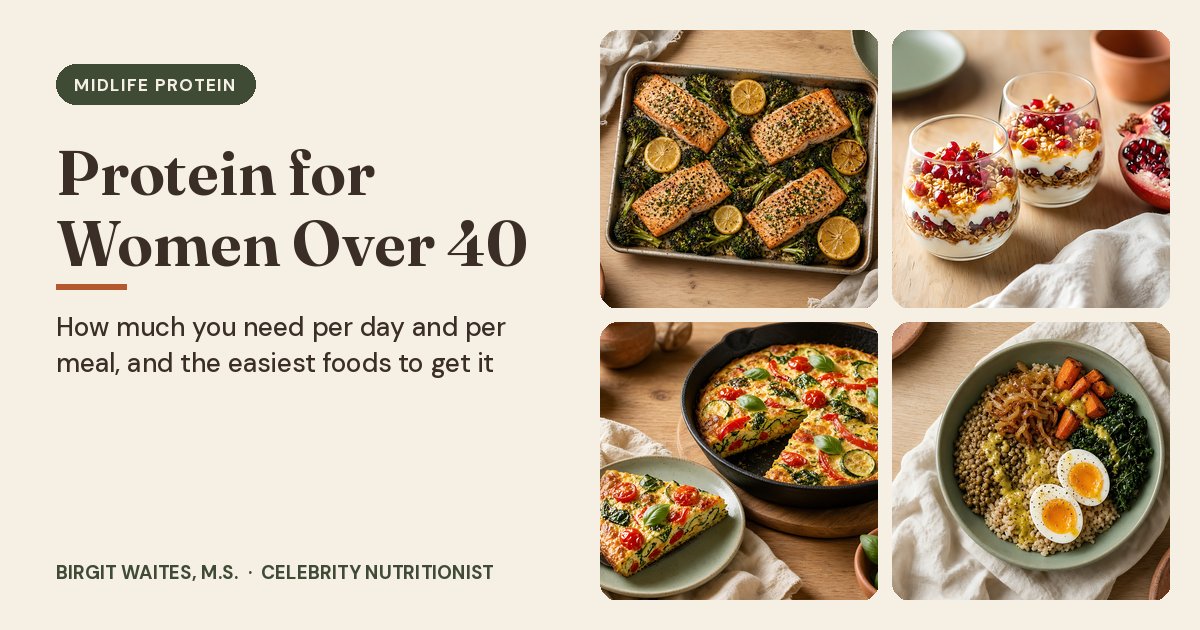
Quick answer: The official minimum (the RDA) for adults is 0.8 grams of protein per kilogram of body weight a day, or about 0.36 grams per pound, which works out to roughly 53 grams a day for a 140-pound woman (Harvard Health). That number is a floor, not a goal. There is no separate official target for women over 40, but an expert group recommends 1.0 to 1.2 g/kg a day for adults over 65 to help keep muscle and strength (PROT-AGE, 2013), and many active midlife women land somewhere between the RDA and that range. Just as important as the daily total: spread protein across your meals (about 20 to 35 grams each) instead of saving most of it for dinner, choose a healthy "protein package" like fish, beans, lentils, yogurt, eggs and nuts, and pair it with strength training. If you have kidney disease or another medical condition, ask your healthcare provider for your number first.
"Protein for women over 40" is one of the most searched nutrition phrases right now, right next to "protein for women over 50," "protein intake for women over 40" and "high protein diet for women over 40." It's also everywhere in the food industry this year: protein shots, protein coffee, protein everything.
After 20+ years of helping women eat well through every life stage, here's my honest take: most of us don't need a protein powder habit. We need a protein breakfast habit. The research points less to one magic number and more to how you spread protein through the day.
At a glance: what trusted sources say
- The RDA is a minimum. 0.8 g/kg (0.36 g/lb) is "the amount of a nutrient you need to meet your basic nutritional requirements," not the specific amount you're supposed to eat (Harvard Health).
- Muscle naturally declines with age. After age 30, people can lose as much as 3% to 5% of muscle mass per decade (Harvard Health).
- Older adults may need more. The PROT-AGE expert group recommends at least 1.0 to 1.2 g/kg a day for adults over 65, and 1.2 g/kg or more for those who exercise (Bauer et al., 2013).
- Spread it out. About 30 grams at each of three meals beat a dinner-heavy pattern for 24-hour muscle protein synthesis in a small study (Mamerow et al., 2014).
Why does protein matter more after 40?
Protein builds muscle, skin, hair, enzymes and antibodies. In your 40s and 50s, three things tend to happen at once:
- Muscle slowly declines. Age-related muscle loss, called sarcopenia, is a natural part of aging, and it can start earlier than most women expect: as much as 3% to 5% per decade after 30 (Harvard Health).
- Your body uses protein less efficiently. As you age, your body doesn't make protein as well, and changes in hormones also play a role in muscle changes (Cleveland Clinic). That's one reason the midlife years, including perimenopause and menopause, are a smart time to pay attention.
- Appetite and routines change. Busy mornings, coffee instead of breakfast, smaller appetites (on or off a GLP-1 medication) and "I'll just have a salad" lunches make it easy to fall short early in the day.
The good news: muscle responds to what you do. Cleveland Clinic lists resistance training and increasing your total protein among the ways to help reverse age-related muscle loss (Cleveland Clinic). Food and movement work as a team.
How much protein do women over 40 need per day?
Start with the RDA, then decide with your provider whether you're likely to do better a little higher.
Step 1: find your minimum. Multiply your weight in pounds by 0.36, or your weight in kilograms by 0.8 (Harvard Health).
Step 2: look at the higher range used in aging research. For adults over 65, PROT-AGE recommends 1.0 to 1.2 g/kg, and 1.2 g/kg or more if you're exercising (Bauer et al., 2013). Women in their 40s and 50s aren't the group that recommendation was written for, so use it as a useful reference point, not a prescription.
| Body weight | RDA minimum (0.8 g/kg) | Range used for older adults (1.0 to 1.2 g/kg) |
|---|---|---|
| 130 lb (59 kg) | about 47 g a day | about 59 to 71 g a day |
| 150 lb (68 kg) | about 54 g a day | about 68 to 82 g a day |
| 170 lb (77 kg) | about 62 g a day | about 77 to 93 g a day |
| 190 lb (86 kg) | about 69 g a day | about 86 to 103 g a day |
Numbers are rounded and calculated from the RDA and the PROT-AGE range. Your own needs depend on your size, activity and health.
Is more always better? Not necessarily. Harvard Health points out that research on the ideal amount is ongoing and far from settled, that the value of high-protein diets for weight loss remains controversial, and that if you add protein you'll usually eat less of something else, so the swaps you make matter (Harvard Health). Swapping a pastry for Greek yogurt is a win; a third protein bar probably isn't.
How much protein should you eat per meal?
This is the easiest change for most women. Typical days are skewed: little protein at breakfast, a big portion at dinner.
In a 7-day crossover study, healthy adults ate the same total protein either evenly (about 31, 30 and 33 grams at breakfast, lunch and dinner) or skewed (about 11, 16 and 63 grams). The even pattern produced 25% higher 24-hour muscle protein synthesis (Mamerow et al., 2014). It was a small study of 8 adults with an average age around 37, so it's a signal rather than the last word, but it matches the everyday advice from Harvard Health that protein may be more effective spaced across meals and snacks rather than loaded up at dinner.
Cleveland Clinic suggests aiming for 20 to 35 grams of protein per meal in the context of age-related muscle loss (Cleveland Clinic). In food terms: a palm-sized portion of fish or chicken, or a generous bowl of lentils with yogurt or eggs.
The best protein foods for women over 40
Here's how much protein common foods provide, so you can build a 20 to 35 gram meal without an app:
| Food | Protein (about) | Source |
|---|---|---|
| 3 oz tuna, salmon, haddock or trout | 21 g | Harvard Health (USDA data) |
| 4 oz grilled sockeye salmon | 30 g | Harvard Nutrition Source |
| 3 oz cooked turkey or chicken | 19 g | Harvard Health (USDA data) |
| 1 cup cooked lentils | 18 g (plus 15 g fiber) | Harvard Nutrition Source |
| 6 oz plain Greek yogurt | 17 g | Harvard Health (USDA data) |
| ½ cup cottage cheese | 14 g | Harvard Health (USDA data) |
| ½ cup cooked beans | 8 g | Harvard Health (USDA data) |
| 1 cup milk | 8 g | Harvard Health (USDA data) |
| ¼ cup (1 oz) nuts | 7 g | Harvard Health (USDA data) |
| 1 egg | 6 g | Harvard Health (USDA data) |
Think "protein package," not just grams. The Harvard T.H. Chan School of Public Health explains that the fats, fiber, sodium and other nutrients that come with a protein food likely make the difference for health. Their example: a cup of lentils brings about 18 grams of protein and 15 grams of fiber with virtually no saturated fat or sodium, while some processed meats come with a lot of sodium. Their evidence-based takeaway is that choosing beans, nuts, fish or poultry in place of red and processed meat can lower the risk of several diseases (Harvard T.H. Chan Nutrition Source).
My favorite midlife protein foods, for that reason:
- Salmon, sardines and other oily fish for protein plus omega-3 fats.
- Lentils, chickpeas and beans for protein plus the fiber your gut bacteria love (see my gut health foods list).
- Plain Greek yogurt, kefir and cottage cheese for an easy breakfast or snack, with a fermented-food bonus for yogurt and kefir.
- Eggs for fast, flexible meals.
- Tofu, tempeh and edamame if you eat mostly plants.
- Nuts and seeds (pumpkin, hemp, chia, ground flax) as protein "toppers."
Can you get enough protein without meat?
Yes. "Get more protein" doesn't have to mean "eat more meat." Harvard Health notes that many plant foods, including whole grains, beans and other legumes, nuts and vegetables, can provide protein too (Harvard Health).
A few tips if you eat mostly plants:
- Make legumes the base of a meal, not a garnish. A full cup of lentils (about 18 g) is a very different meal from a spoonful of chickpeas on a salad.
- Stack two or three sources. Lentils plus yogurt dressing plus pumpkin seeds, or tofu plus edamame plus a whole-grain base.
- Vary your plants. My free 30 Plants a Week Checklist makes that easy to count.
An easy high-protein day for women over 40
Here's one example day with about 25 to 30 grams of protein at each meal, using the food numbers above. It adds up to roughly 80 grams, close to the upper "older adults" range for a 140 to 150-pound woman, without a single shake.
Breakfast (about 24 g): Greek yogurt bowl. 6 oz plain Greek yogurt (17 g) with berries, a sprinkle of ground flax and ¼ cup nuts (7 g). Prefer savory? Two eggs (12 g) with ½ cup cottage cheese (14 g) and sautéed spinach on whole-grain toast.
Lunch (about 24 g): lemony lentil salad. 1 cup cooked lentils (18 g) with cucumber, tomato, herbs, olive oil and lemon, topped with a sliced egg (6 g). Add a little feta if you like.
Dinner (about 30 g): sheet-pan salmon and broccoli. 4 oz salmon (about 30 g) roasted with broccoli and a squeeze of lemon, with a scoop of quinoa or brown rice.
Optional snack: a glass of milk or kefir (milk has about 8 g per cup), or a small handful of roasted chickpeas.
If your appetite is small, keep the same rhythm with smaller portions and lean on the most protein-dense foods first: yogurt, cottage cheese, fish and eggs. If you're using a GLP-1 medication, my guide to natural GLP-1 foods covers protein-first eating on small appetite days.
Does protein help with menopause belly fat or weight?
Protein is one helpful piece of the midlife picture, not a magic fix. Harvard Health is candid that the verdict on higher-protein diets for weight loss is still out: some studies support it and some don't (Harvard Health). What protein can do is make meals more satisfying and support the muscle you're working to keep with strength training.
For the full midlife picture, including fiber, fermented foods, sleep and five easy recipes, read Menopause Belly Fat: Why It Happens and 5 Gut-Friendly Perimenopause Recipes and my foods to eat during menopause list.
Pair protein with strength training
Protein gives your muscles the raw materials; movement gives them the reason to use them. Resistance training, such as exercise with resistance bands, weights or your own body weight, is what Cleveland Clinic highlights for age-related muscle loss (Cleveland Clinic). The PROT-AGE group likewise recommends both endurance and resistance exercise at a level that's safe for you (Bauer et al., 2013). Start where you are: two short sessions a week of squats to a chair, wall push-ups and band rows is a wonderful beginning.
Who should check with a healthcare provider first?
Most healthy women can comfortably build meals around 20 to 35 grams of protein. Talk with your healthcare provider or a registered dietitian before raising your protein intake if you:
- Have chronic kidney disease or reduced kidney function. Your kidneys remove the waste from protein, and some people with kidney disease may need moderate amounts of protein, while too little can lead to malnutrition, so the right amount is individual (NIDDK).
- Have another medical condition, take medications (including GLP-1 medications), or are pregnant or nursing.
- Are considering protein powders or supplements. Food first is my rule.
Frequently asked questions
How much protein does a woman over 40 need per day?
The RDA minimum is 0.8 grams per kilogram of body weight, or about 0.36 grams per pound, which is around 53 grams a day for a 140-pound woman. There's no separate official number for women over 40. An expert group recommends 1.0 to 1.2 g/kg for adults over 65 to help keep muscle and strength, so many active midlife women aim somewhere between the RDA and that range. Ask your healthcare provider about the right amount for you.
How much protein should I eat per meal?
A practical target for most women over 40 is about 20 to 35 grams of protein per meal, spread across breakfast, lunch and dinner. In one small study, eating about 30 grams at each meal led to higher 24-hour muscle protein synthesis than eating most of the day's protein at dinner.
Can I get enough protein without meat?
Yes. Lentils, beans, tofu, tempeh, edamame, yogurt, cottage cheese, eggs, nuts and seeds all add up. A cup of cooked lentils has about 18 grams of protein plus 15 grams of fiber. Make legumes the base of the meal and combine two or three sources.
Does eating more protein help with menopause belly fat?
Protein can make meals more filling and helps support muscle alongside strength training, but it isn't a guaranteed weight-loss tool. Research on high-protein diets for weight loss is mixed. A whole-food approach with protein at each meal, plenty of fiber, regular movement and good sleep is the most balanced place to start.
Is too much protein bad for you?
For healthy adults, the bigger question is usually the protein package: fish, beans, lentils, nuts, poultry and yogurt are better everyday choices than lots of red and processed meat. People with kidney disease may need to keep protein moderate, so if you have a kidney condition or any medical condition, check with your healthcare provider before increasing protein.
What is a good high-protein breakfast for women over 40?
Try 6 ounces of plain Greek yogurt with berries and a quarter cup of nuts (about 24 grams of protein), or two eggs with half a cup of cottage cheese and spinach on whole-grain toast (about 26 grams before the toast). Both take about five minutes.
Your next step
This week, try one change: add a protein-rich breakfast (Greek yogurt bowl or eggs with cottage cheese) on at least five mornings. Notice how your mid-morning hunger and energy feel.
- 🎁 Get my free 5 Protein-First Habits guide with five protein-first habits, a small-appetite sample day and my Protein Berry Overnight Oats. You'll find all my free printables on my Free Guides page.
- 🍽️ Want the full plan? My Protein-First Plate guide has protein-first, fiber-rich meals that keep you full and help protect muscle, on or off a GLP-1. For midlife, see Nourished Through the Change, and browse everything in my Payhip shop.
- 📖 Keep reading: Menopause Belly Fat and 5 Perimenopause Recipes and Natural GLP-1 Foods.
Sources
- Harvard Health Publishing. How much protein do you need every day? Updated June 22, 2023.
- Harvard T.H. Chan School of Public Health, The Nutrition Source. Protein.
- Bauer J, et al. Evidence-based recommendations for optimal dietary protein intake in older people: a position paper from the PROT-AGE Study Group. J Am Med Dir Assoc. 2013;14(8):542-559.
- Mamerow MM, et al. Dietary protein distribution positively influences 24-h muscle protein synthesis in healthy adults. J Nutr. 2014;144(6):876-880.
- Cleveland Clinic. Sarcopenia (Muscle Loss): Symptoms & Causes.
- Harvard Health Publishing. Preserve your muscle mass.
- National Institute of Diabetes and Digestive and Kidney Diseases (NIDDK). Healthy Eating for Adults with Chronic Kidney Disease.
Birgit Waites, M.S.
Birgit Waites, M.S. is a Celebrity Nutritionist with an M.S. in Natural Medicine and a Board Certified Holistic Health Practitioner (AADP), with 20+ years of experience in holistic nutrition. She's the author of Healing From Within and Nourished Through the Change, and these days she's traveling the world, cooking and writing as she goes.
Disclaimer
Wellness education, not medical advice. Content in this article is for general educational purposes only and is not intended to diagnose, treat, cure or prevent any disease. Please talk with your healthcare provider before changing your diet, exercise or supplements, especially if you have a medical condition, are pregnant or nursing, or take medication.